Virtvs Exercit / Vot Xx
This type –
‘Two captives std. beneath vexillum inscribed VOT/X or VOT/XX’ was minted for
Constantine and Licinius augusti and Crispus, Constantine II and
Licinius II caesares. The augusti celebrated their 20th
vows (VOT XX) and the caesares their 10th (VOT X). The type
for the caesares was only minted in Aquileia and Siscia. Imitations of
this type occur in the Danube region, using Siscia protoypes. Many ‘hybrids’
exist, pairing VOT X of the augusti with a portrait of a caesar
and vice versa. This is another indication that ‘barbarous’ mints didn’t
reproduce one particular prototype, but combined several obverse and reverse
designs as they saw fit.
Constantine
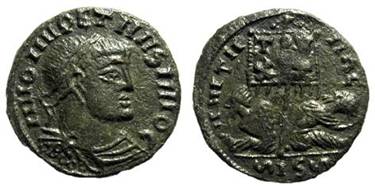
2.45g/17.7mm
This imitation of a Constantine prototype has a
typical SIS-mint mark with S’s on the side. Note also the reversed TOV in the
vexillum. By the way, RIC lists no laureate bust for Constantine for this issue
of Siscia.
Crispus
and Constantine II
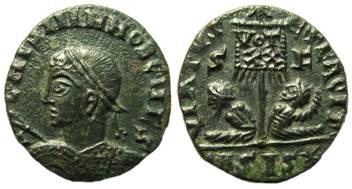
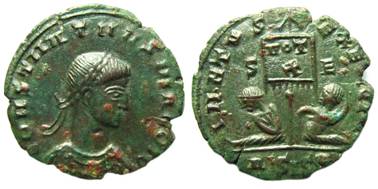
L: 2.64g/17.5mm;
R: 2.89g/18mm
These coins
have a Siscia mintmark which unmistakenly identifies the origin of the
prototype(s). The obverse legend of the coin on the left hand side has NOB CAES
readable, while the number of preceding letters suggests CRISPVS was meant. The
reverse, however, has VOT/XX on the vexillum. This number was, as mentioned
above, only minted for Constantine and Licinius, celebrating their 20th
vows. An emission of Siscia of 320 has S/F in fields and a SIS* mintmark, which
are rendered very well on this coin. The coin on the right has a portrait of
Constantine II caesar. The beginning of his name is clearly
identifyable. His father, Constantine the Great, only has a helmeted bust. On
the reverse of the coin the letters S/E appear, in stead of the prototype’s
S/F.
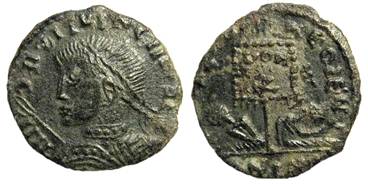
The coin
above is from the same group of irregular coins as the two coins above. It
shows a bust of one of the Caesars and a corresponding ‘X’ on the vexillum. The
exergue shows a clear barbarous Siscia mintmark SIS, with the two S’s on the
side.
Licinius
I
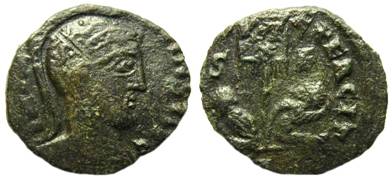
2.31g/18mm
The coin
above is rare, partly because the original is also rare. It features the bust
of Licinius and has the 320 prototype with S/F in fields. The bust is
identifyable as Licinius because the portrait has a beard and Licinius was the
only one at the time who was portrayed with a beard. However, the vexillum has
VOT X, the 10th vows, of the caesares. This means this is
another ‘hybrid’ imitation.