The translation of the codewords AEQVITI, IOBI and HPKOYΛI
by Gert Boersema
Like many collectors of ancient coins, as soon as I read about the
‘coded series’ of the emperors Probus, Diocletian and
Maximian I became intrigued by them. Apart from the
short introduction in RIC, there is plenty of information to be found on the
net. However, the question what the words mean exactly (or rather, what
possible translations can be offered) remains. In this article I will try to
give a short survey of several possible translations of the codewords.
I will also try to evaluate the evidence pro and con and offer
some thoughts of my own.[1]
I - AEQVITI
For the emperor Probus, the word ‘AEQVITI’
appears on four series of antoniniani, struck by the
mints of Rome and Ticinum in the years 280-282. Rome
spells the codeword ‘AEQVITI’, Ticinum spells
‘AEQVIT’ and ‘EQVITI’.
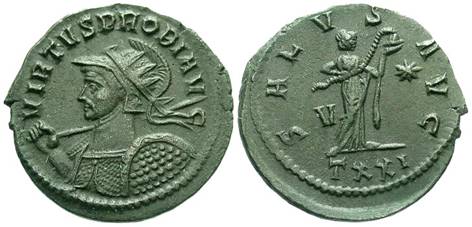
Figure 1: Antoninianus
of Probus from Ticinum’s
third officina, code letter EQVITI
In this article I will focus on the translation of the codewords. There is plenty
of information to find on the net (see the bibliography) about the composition
of the coded series, so I will not go into further detail about that here.
There are two possible roots for the codeword AEQVITI. It can be derived
from aequitas (equity, just, fair dealing), or
it has something to do with eques (horseman,
knight). I will weigh several possible translations, beginning with the least
likely.
‘For Aequitas’
(aequitati)
That the codeword derives from aequitas
was brought forward as far back as 1873, by the discoverer of the code, Dr.
A. Missong (who, by the way, had a collection of
14.000 coins of the emperor Probus). In the
publication of his discovery, he explained the words as an abbreviation of the
word aequitas in the dative case – aequitati (‘for Aequitas’).
Missong thought the word referred to the greater equability
and uniformity of the coinage at the time, in regard to the great diversity of
dies in the first years of Probus’ reign. It has also
been mentioned that this word is found to be associated with the figure of
Moneta with scales and cornucopiae and sometimes with
the three Monetae. This theory has long been
abandoned:
· Most importantly, the Latin would
make no sense: AEQVITI as an abbreviation of aequitati
is unlikely at best.
· If the codeword refers to Aequitas, it would be reasonable to expect the
personification of Aequitas (or Moneta for that
matter) appearing as a reverse-type on coded coins. This is not the case.
· The evidence for the second ‘root’
is more compelling, as we will see later on.
Later writers all agree that the codeword, in one way or another derives
from eques (‘horseman’) and not from
words associated with aequitas.
‘For the Horseman’ (Equiti)
The codewords are all acceptable as the dative
case for eques. Or in other words: they can
represent the ‘dedicatory’ form of the word. Before I proceed, one remark is
necessary here:
· The word eques
(and like wise the dative case equiti), written in flawless Latin would not have
the initial ‘a’, the letter we encounter in the spelling of the codeword in both
Rome (AEQVITI) and Ticinum (AEQVIT, 1st
series). However, this particular phenomenon, called a ‘diphthong’, which is
technically a spelling-error, is encountered on other coins of this period.[2]
Not very often, but often enough to accept that in this period both equiti and aequiti
are valid variants in the spelling of the same word.
But the difficulty remains that eques
(and likewise the dative case equiti) can
mean a number of things.
The first possible translation of equiti
is ‘for the Horseman’. Probus as a horseman. At first
glance, this translation will seem very plausible to the collector’s mind, as
one of Probus’ most famous reverse-types is ‘the
emperor on horseback’.

Figure 2: Antoninianus
of Probus from Rome with the emperor on horseback
But as a matter of fact, this type has nothing to do with Probus being a horseman, but has everything to do with Probus’ arrival in Rome in 277 AD. This particular type
accompanying the legend ADVENTVS AVG is the traditional numismatic
commemoration of this event in the coinage of many an emperor before Probus. Furthermore, being called a ‘horseman’ would not
have been very honorable to the emperor’s mind (or to
the Roman mind). Consider for comparison the titles Probus
is known to have had during his lifetime: ‘good/perpetual imperator’ (bonus/perpetuus imperator), ‘invincible emperor’ (invictus augustus)
and last but not least ‘god and lord’ (deus
et dominus). Also, ancient sources remain silent
about Probus being a horseman. This means the theory
that the codewords refer to the emperor as a horseman
will need some additional evidence. (And there is! I will return to this topic
later on)
‘For the knight’ (Equiti)
The Roman aristocracy was composed of two ranks. The knights (equites) formed the lower part, the senators the
upper part. Anyone coming from a family that could boast a consul as a
forefather belonged to the senatorial rank. The knights were wealthy Romans
without consular forebears. Only if a man of equestrian rank had managed to
gain access to the senate (after having been appointed quaestor
or consul) he obtained senatorial status. In the time of Probus
these ranks still existed, but the strict division was not so clear anymore.
The senators had lost their monopoly on the chief magistracies.
I can be short about this possible translation. It is impossible that
‘for the knight’ refers to Probus, because at the
time the series were minted, the emperor – already having been consul thrice –
technically belonged to the senatorial rank. It is very unlikely someone else
was honored by the series. As a rule, only the
emperor and members of the imperial family appear on imperial coinage. Also,
for the time of the emperor Probus, there appear no
candidates for this kind of honor in the ancient
sources.
‘For the equestrian order’ (Equiti)
The word eques can also refer to
a collective of equites, or in other words: it
can refer to ‘all Roman knights’. Along these lines our next possible translation
is ‘for the equestrian order’, understanding the coded coins as dedicated to
the Roman knights. This does not seem very likely either. There are no
precedents for a dedication of coins to the equestrian order and the sources do
not mention them as having played a special role during Probus’
reign.
However, the introduction to the coinage of Probus
in RIC speculates that the reverse portraying the emperor as princeps juventutis[3]
‘was perhaps an allusion to his close connection with the Equester
Ordo’.

Figure 3: Antoninianus
depicting the emperor Probus as princeps
juventutis
As far as I am concerned there are no grounds whatsoever to assume this:
· The title princeps
juventutis was originally a Republican title,
borne by commanders of the equestrian order, mostly young men of senatorial
rank. In imperial times the title was bestowed on ‘caesares’,
the heirs apparent to the imperial title. In later times we see emperors assume
the title (Aurelian was the first) and later still princeps
juventutis becomes little more than one of the
many honorary titles borne by the emperor. The original connection with the
Roman knights is no longer explicit.
· That Probus
‘mechanically’ assumed the title princeps juventutis when he became emperor is confirmed by
numismatic evidence. The antoninianus bearing the
legend PRINCIPI IVVENTVT, struck in Ticinum, was
minted right after Probus became emperor in 276.
Furthermore, this first emission of Ticinum was
identical to the last emission of Florian, Probus’ predecessor. Probus just
copied Florian’s honorary title along with the rest
of his predecessor’s reverses! (Siscia, following the
example of Ticinum, struck an aureus
bearing this title as a part of its second emission of 277.)
· There is a gap of three years
between the issue of the princeps juventutis-types and the coded series: after Siscia’s aureus the title
vanishes from Probus’ coinage. This makes it hard to
believe the issues are related to the AEQVITI-series as expressing the same
‘close connection’.
It will be clear that in this author’s opinion the translation ‘for the
equestrian order’ does not seem to be very likely.
‘For the cavalry’ (Equiti)
Another collective of horsemen is of course ‘the cavalry’. Along these
lines our next possible translation of the codewords
is ‘for the cavalry’. This is the first possibility that has something to say
for it. Like the introduction in RIC states: ‘It is not unlikely that Probus, whose warlike operations extended over a great
area, may also have owed much to the mounted arm, and desired to express that
indebtedness.’
As a matter of fact, we have some kind of precedent for this. Another
emperor had ‘expressed his indebtedness’ to the cavalry on his coinage a few
years earlier. During the reign of Postumus the mint
of Milan (possibly under control of Postumus’
commander of the horse Aureolus) issued a series of antoniniani mentioning the mounted forces. We encounter the
following reverses: CONCORDIA, FIDES, PAX and VIRTVS EQVITVM.

Figure 4: Antoninianus
of Postumus minted at Milan in honor
of the cavalry
All these legends are in the nominative case (the harmony of the cavalry
– not: ‘for the harmony’). This means the ‘dedicatory’ nature of the series is
not apparent right away.
· It is interesting to see that Postumus’ cavalry-coins show the same errors/variants in
the spelling of the word for ‘horsemen’ as our codewords
do. There are legends with AEQVIT and AEQVITVM alongside the ones with EQVITVM!
‘Equitius’
(Equitius)
Theodor Mommsen was the first to identify the codewords
as the name Equitius (1887). He writes it is
‘evident’ that Equitius must have been the official
in charge of the mint. This theory (or rather: this wild speculation) has not
produced any followers, firstly because the series of Rome and Ticinum’s third series are contemporary (both emissions
dating 282 AD) which would mean this hypothetical official was in charge of two
separate mints at the same time. Secondly, and more importantly, there is a
much more likely candidate for the name: one historical source mentions the
name Equitius as one of the names of the
emperor Probus himself. This source is his Epitome.[4] Karl Pink, the
author of the only ‘recent’ study on the coinage of Probus
(1949), chooses this name, referring to Probus, as
the explanation of the codewords.

Figure 5: ‘Coded’ antoniniani of Probus from Ticinum’s 1st and 2nd officinae with the code letters EQVITI
Equitius is almost certainly a so-called signum: a ‘nickname’. Often, signa
were Latin translations of a foreign (Greek or Egyptian) name. This is also
the case with the name Equitius. It translates
the Greek name Ippius (or Hippios), as becomes clear from an inscription of
245 AD which reads: ‘M IPPIVS … SIGNO EQVITII’ (Translation: Marcus Ippius … with the signum
of Equitius’).[5] Above, I stated the theory ‘Probus as a horseman’ would require some extra evidence.
Well, here it is: The Greek word Hippios means
‘horseman’.
Before examining the ancient source mentioning Probus’s
signum, two remarks are in order on the
translation of Equitius:
· It most probably has nothing to do
with Probus being ‘no mean commander of the horse’,
as the introduction in RIC states.
· It
also has nothing to do with the, relatively rare, Roman family-name Equitius.
It is a compelling coincidence that the codewords
could be referring to Probus’ nickname. But how
certain can we be that the emperor really bore this name? First a couple of
considerations contra:
· The signum
is found only in the Epitomes (36,2). This is a kind of ‘abbreviation’
of the work De Caesaribus by the ancient
historian Aurelius Victor. The date of the Epitomes is unclear, but it
will necessarily have to be after Victor published his work in about 360 AD.
· The
anonymous author of the Epitomes used other sources in addition to
Victor’s work. His main interest was biography (i.e. gossip). His reputation
for reliability is not particularly high (as is the case with all of the
written sources dealing with Probus).
· All
this means that the signum is absent in
all other known (and earlier) written sources. Aurelius Victor’s ‘original
work’ does not mention the name, nor does the writer of Probus’
Vita in the Historia Augusta. Zosimus, a Greek historian writing in the fifth centery AD does not mention the signum
either.
· More
importantly: not a single coin or inscription calls Probus
Equitius.[6]
I stated above that the ancient sources do not mention Probus as being a horseman. There is, however, a story in
the Historia Augusta relating how Probus, when he was serving as a general under the emperor
Aurelian, acquired a famous horse. This story may have some sort of connection
with his nickname. Here it is:
‘Once, indeed, when a horse was found among the booty … which, though
not handsome or especially large, was reputed … to be able to run one hundred
miles in a day and to continue for eight or ten days, all supposed that Probus would keep such a beast for himself. But first he
remarked, “This horse is better suited to a soldier who flees than to one who
fights,” and then he ordered the men to put their names into an urn, that the
one drawn by lot should receive the horse. Then, since there were in the army
four other soldiers named Probus, it so chanced that
the name of Probus appeared on the lot that first
came forth, though the general’s name had not been put into the urn. And when
the four soldiers strove with one another, each maintaining that the lot was
his, he ordered the urn to be shaken a second time. But a second time, too, the
name of Probus came forth; and when it was done for
the third and the fourth time, on the fourth time also there leaped forth the
name of Probus. Then the entire army set apart that
horse for Probus their general, and even those very
soldiers whose names had come forth from the urn desired it thus.’
It is possible that Probus’ signum gave rise to the fabrication of this
legendary story. There are many examples of stories explaining names and
situations to be found in ancient myth and historiography. This could well be
another one. It explains how the emperor got his wonder-horse and also why he
can be called Equitius. It also deals with the
problem that being called a ‘horseman’ is not particularly honorable.
Probus is hesitant at first to accept even a
wonder-horse. Later he does accept it, but only after it is made very clear
that it is ‘supposed to be’.
More compelling evidence for understanding the codewords
as referring to Probus’ signum
comes in the guise of the coded series of Diocleatian
and Maximian. These emperors, as we will see, may
have also put their nicknames on coded coins. But first the question is: in what
way does the name Equitius appear on
the coded coins?
The first possibiltity is that the mints of
Rome and Ticinum just abbreviated the name in the
normal, nominative form: ‘Equitius’. The length of
the abbreviation is confined by the number of officinae
in both mints: Rome had seven officinae, Ticinum had six. For this reason the name was abbreviated
to seven and six letters. We encounter (A)EQVITI[VS], without ‘VS’, and, in the
case of Ticinum’s first series, AEQVIT[IVS] without
‘IVS’). Maybe if Ticinum had had eight offinae, I would now have been discussing the
EQVITIVS-series.
‘Of/Belonging to Equitius’
(Equitii)
Karl Pink, the author of the only extensive study on Probus’
coinage chooses another translation. He explains the codewords
as the name Equitius appearing in the genitive
case.[7]
And indeed, our codewords are all acceptable
as the genitive case of the name Equitius:
(‘Of/Belonging to Equitius’) after we consider the
following:
· The additional ‘a’ in the codewords can be seen as a variant in spelling (see the
remark on the ‘diphthong’ above).
· The
genitive case in flawless Latin would read Equitii,
with an extra ‘i’. Probably because the ancient
Romans did not pronounce the second ‘i’, this letter
is omitted on a regular basis in written texts (likewise fili
instead of filii).
However, the use of genitive cases for names of emperors is more
problematic than Pink makes it appear in his article. I will return to this
matter later on.
II - IOBI and HPKOYΛI
Approximately a decade after Probus’ coded
series, the Siscia mint produced a few series of
coded antoniniani for the emperors Diocletian and Maximian (see the article by Chip Scoppa).
In the exergues of the coins of Diocletian we encounter the word IOBI split up
three-way (I, O and BI) and likewise for Maximian the
word HPKOYΛI (HP, KOY, and ΛI).

Figure 6: Antoninianus
of Diocletian from Siscia’s third officin
with the code letters IOBI
· It is peculiar that these words,
which are clearly Latin, appear in Greek lettering. (The words derive from
‘Jupiter’ and ‘Hercules’, not from their Greek counterparts Zeus and Herakles).
· It
is even more peculiar that (maybe) the Latin grammatical decline also appears
in Greek lettering! This phenomenon, however, (the transliteration of foreign
words, including grammatical decline, into another language) is not unique and
can be found in inscriptions also.
But what can these words mean? The first possibility, as stated above,
is that they represent the nicknames of the emperors in question.
‘Jovius’,
‘Herculius’ (Iovius
and Herculius)
At the time the coded series were minted, the empire was ruled by
Diocletian in the east and Maximian as his co-ruler
in the west. As a part of the reorganization of the Empire, the emperors
established an emperor-cult on a scale that had not existed earlier.
Diocletian, the senior Augustus, presented himself as the manifestation of
Jupiter, while Maximian was to be seen as Hercules
made flesh. It is well-known to collectors that Maximian
went very far in identifying himself with his patron deity (as can be seen on
the coins portraying him with a lion skin) and that he assumed the name Herculius. Not so well-known is the fact that
Diocletian, on the other hand, assumed the name Jovius.
By assuming these names, which are modifications of the names of the patron
deities, the emperors implied having a close connection to these particular
gods.
Joseph van Kolb, the man who must be credited with the discovery of the codewords in 1872, states that the codewords
refer to these nicknames.[8]
There are two ways in which the names can be appearing on the coins.
Like it is the case with Equitius (see above),
the codewords can be the emperors’ nicknames in the
abbreviated nominative case: IOVI[VS] and HERCULI[VS]. But, considering there
was enough space to put ‘KOY’ in the exergue of the second coin, why abbreviate
at all?
It remains a noteworthy coincidence that: 1) all of the codewords can be understood as referring to the nicknames
of the three emperors and 2) the manner of abbreviation is apparently the same:
in all the codewords the last syllable – us – of
the names Equitius, Jovius
and Herculius is omitted.
‘Of/Belonging to Jovius,
Of/Belonging to Herculius’ (Iovii
and Herculii)
The codewords are also acceptable as the
genitive form of those nicknames (see the remark on the extra letter ‘i’ in the section ‘Of/belonging to Equitius’).
This gives the translation ‘Of/Belonging to Jovius’
and ‘Of/Belonging to Herculius’. Our codewords appear in this way on a silver medaillon of Diocletian and Maximian
bearing the legend MONETA IOVI ET HERCVLI AVGG – ‘coin of the emperors Jovius and Herculius’.

Figure 7: Antoninianus
of Maximian from Siscia’s
second officina with the code letters HPKOYΛI
‘For Jupiter, For Hercules’ (Iovi and Herculi)
As a final possibility, the codewords may
represent the dative case of the names Jupiter and Hercules. This way we get
the translation ‘for Jupiter’ and ‘for Hercules’ and the coins are understood
as ‘dedicated’ to those deities. There are numerous examples of coins
‘dedicated’ to the gods, which is often clear because their names appear in
‘dedicatory form’, i.e. the dative case. In the coinage of Diocletian and Maximian we see examples of this in legends like IOVI
CONSERVATORI AVGG (‘for Jupiter, protector of the emperors’) and HERCULI
PACIFERO (‘For Hercules the peace maker’) – note that the words used in these
legends are also our codewords.
III - Conclusion
Considering all these possible translations, two lines of interpretation
remain, as far as I am concerned. Either the codewords
are a rendition of the three emperor’s nicknames or they are to be understood
as dedications: in the case of the AEQVITI-series to the cavalry, in the case
of IOBI and HPKOYΛI to Jupiter and Hercules.
However, the thing that bothers me about Pink’s version of the
nickname-theory, is that the names would have to appear in the genitive
case:
· In the whole history of Roman
imperial coinage we never encounter a name of an emperor in the genetive case by itself.[9] Names appear either in the
nominative case (IMP PROBVS AVG – ‘the emperor Probus’)
or in the dative case (IMP PROBO AVG – ‘dedicated to the emperor Probus’). A genitive case never appears in isolated form,
but is always accompanied by a word requiring it (VIRTVS PROBI AVG ‘the
courage of the emperor Probus, see also the legend on
the medaillon quoted above).
· So:
if the codewords really are the nicknames of the
emperors in the genitive case (expressing that the coins ‘belong to the
emperor’[10]), the mints of Rome, Ticinum and Siscia would be
running against three centuries of numismatic convention and tradition.
Pink (1949) does not really explain this problem, nor does Colombetti
(1989), who just reiterates Pink’s interpretation. Pink takes the appearance of
the signa in the genitive case for granted but
the case for this reading is not as clear-cut as he makes it appear.
· If
Probus’ signum was
put on the coins, it is much more probable that a dative case (Equitio) or a nominative case (Equitius)
would have been used. Considering the fact that, as stated above, the words can
be understood as the nominative case in abbreviated form, why choose the more
problematic reading?
IV – Epilogue: Who would notice?
Trying to make sense of a code is a dangerous
undertaking. A code, by nature, is not meant to be understood by outsiders.
Consider the Siscian coins of Diocletian and Maximian: the codewords are, as
stated above, Greek translitterations of Latin names,
maybe even including the Latin grammatical decline. This is very strange,
considering the fact that Siscia was a part of the
Latin-speaking region of the Roman Empire.
Doug Smith, in an email to this author,
remarks: ‘In general, I would see use of Greek letters in a Latin region (or
vice-versa) as a sign that the code was not intended to be read by anyone
outside the mint. This is rather like the pull date codes used in grocery
stores. They don’t want you to know when it was packaged.’
It all comes down to common sense, really. Imagine the chances for an
average citizen of Roman Siscia to: 1) be able to
read, 2) be able to read Greek, 3) of all the coins in circulation get his
hands on three different coded coins of the same emperor, 4) study the reverses
close enough to notice the letters in the exergue at all, and 5) discover that
some letters in the exergue of three particular coins – read one after another
in the right order – spell out a word. I think the odds will be against him.
The same line of thought applies to the AEQVITI-series: the chances for
‘the average man’ actually noticing the codeword are very slim. These
considerations shed some doubt on the explanation that with the series, the
emperor Probus desired to ‘express his indebtedness
to the mounted arm’. A code that would not have been noticed by almost
everybody is a very peculiar way to do that.
It is reasonable to assume, in my opinion at least, that the meaning
(and perhaps even the existence) of the coded coins was known only to the
workers and officials at the mints. Perhaps the letters were nothing more than
control marks. These control marks are encountered frequently on Roman coins,
their purpose being probably to enable the mint workers to distinguish between
the different emissions. Usually these control marks do not have a deeper
meaning, but in the present case several of them spell out a word. About the
question why the officials at the mints of Rome, Ticinum
and Siscia chose these particular words, we will
probably never be sure.
Bibliography
Colombetti, Luigi, ‘Cenni sulla monetazione di Probo gli antoniniani delle serie (A) EQVIT (I) (zecche de Roma e Ticinvm).’ La numismatica 20, 11 (1989) p. 339-340.
Dannhäuser,
Erich, Untersuchungen
zur Geschichte des Kaisers Probus (276-282).
(Inaugural Dissertation) 1909.
Kolb, Joseph von, ‘Enträthselte Siglen auf Münzen Diocletians and Maximians’ Numismatische Zeitschrift (1872) p. 24-30.*
Kolb, Joseph von, ‘Enträthselte Siglen auf Münzen Diocletians and Maximians’ Numismatische Zeitschrift (1873) p. 116-121.
Missong, A, ‘Gleichartig systemisirte Münzreihen unter Kaiser Probus’, Numismatische Zeitschrift (1873) 102-115.*
Mommsen, Theodor ‘Equitius.’, Zeitschrift für Numismatik, 15 (1887) p. 251-252.
Mowat, R, ‘Combinaisons secrète de lettres dans les marges monétaires de l’empire Romain’, Revue Numismatique, 1897 67-81.
Pink, Karl, ‘Der Aufbau der römischen
Münzprägung in der Kaiserzeit.
VI/I, Probus.’,
Numismatische Zeitschrift 73 (1949), p. 13-74.
Real-Encyclopädie der klassischen Altertumswissenschaft: lemma ‘Aurelius’, ‘Equitius’, ‘Signum’.
Roman Imperial Coinage volume V part II.
* The articles announcing the discovery of the coded coins.
Worthy of mention are the following
web pages:
Chip Scoppa’s overview
of the coded coins of Probus and his
fascinating article based
on the ‘Siscia mule’:
http://forumancientcoins.com/forvm/Articles/Probus_AEQVITI/AEQVITI_coins_of_probvs.htm
http://forumancientcoins.com/Articles/east_meets_west.htm
Doug Smith’s pages on the coded
series:
http://dougsmith.ancients.info/equiti.html
http://dougsmith.ancients.info/code.html
A comprehensive site of the coinage
of Probus worth visiting:
http://probvs.info/probvs/e-equiti.html
This article can also be read on www.forumancientcoins.com at the following link:
http://forumancientcoins.com/Articles/Codeword_Translation.htm
[1] I would like to thank Chip Scoppa and Doug Smith for their comments and for taking the
time reviewing my work. Also I would like to thank Dick Boersema,
Virtvsprobi, Bob Vuijk, Sylviane Estiot and Curtis Clay
for their help.
[2] We find PIAETAS as well as PIETAS,
SECVLI alongside SAECVLI, and on coins of Postumus,
minted only a few years earlier, the word EQVITVM, which is also derived from
our ‘root’-word eques, is sometimes spelled AEQVITVM.
[3] On two coins: An antoninianus of Ticinum (RIC 318)
and an aureus of Siscia
(RIC 892).
[4] Epit. de Caes. 36,2 reads: ‘Sed, cum magna pars
exercitus Equitium Probum, militiae peritum legisset, Florianus...’
[5] CIL III 2706 reads: ‘M. Ipp[ius] L. f. Stel(latina tribu)
Benevento Vitalis, (centurio)
coh(ortis) VIII vol(oluntariorum), - - sig(no) Equitii’.
[6] So either 1) the signum has its origin in an ancient source, known by
the author of the Epitomes, but unknown to us, or 2) the signum is a fabrication of the Epitomizer, or
3) the signum is the result of a copying-error
(for ‘Aurelium’ perhaps) in the surviving manuscripts
of the Epitomes. It is of course possible the name will occur in some
future discovery. According to Dannhäuser
Equitius Probus was
the name Probus bore before assuming the name Marcus
Aurelius Probus when he became emperor (1909 p.13/14
note). This would explain why the name doesn’t appear on his coinage.
[7] In the most recent publication on
the subject, Colombetti (1989) reiterates Pink’s
interpretation.
[8] Von Kolb, in his article
(1872) announcing his interesting discovery, writes that his curiosity was
captured by the long, strange string of letters (‘BXXIKOY’) in the exergue of a
coin of Maximian. He found out the about the coded
series after studying the Vienese collection. It is
interesting to see that Missong published his
discovery of the codes on Probus’ coins only one year
later.
[9] I could find one example on Doug
Smith’s site. A Siscian bronze of Constans
as caesar bearing the legend FL CONSTANTIS BEA C (RIC
VII 238 - Siscia).
[10] This is the most probable explanion of the ‘isolated’ genetive
case in which names of rulers appear on Greek coins.